Jobs4Blue Agent Portal
Jobs4Blue Agent Portal
Jobs4Blue Agent Portal
Jobs4Blue Agent Portal
Transforming fragmented operational workflows into a centralized platform for enterprise-scale coordination
Transforming fragmented operational workflows into a centralized platform for enterprise-scale coordination
Transforming fragmented operational workflows into a centralized platform for enterprise-scale coordination
As the sole Product Designer, I led the redesign of Jobs4Blue's Agent Portal, transforming fragmented operational workflows into a centralized platform for managing high-volume job requests. Partnering with enterprise clients, operations leadership, and field agents, I streamlined complex processes, improved visibility across operational data, and enabled faster decision-making at scale.
As the sole Product Designer, I led the redesign of Jobs4Blue's Agent Portal, transforming fragmented operational workflows into a centralized platform for managing high-volume job requests. Partnering with enterprise clients, operations leadership, and field agents, I streamlined complex processes, improved visibility across operational data, and enabled faster decision-making at scale.
As the sole Product Designer, I led the redesign of Jobs4Blue's Agent Portal, transforming fragmented operational workflows into a centralized platform for managing high-volume job requests. Partnering with enterprise clients, operations leadership, and field agents, I streamlined complex processes, improved visibility across operational data, and enabled faster decision-making at scale.
As the sole Product Designer, I led the redesign of Jobs4Blue's Agent Portal, transforming fragmented operational workflows into a centralized platform for managing high-volume job requests. Partnering with enterprise clients, operations leadership, and field agents, I streamlined complex processes, improved visibility across operational data, and enabled faster decision-making at scale.
As the sole Product Designer, I led the redesign of Jobs4Blue's Agent Portal, transforming fragmented operational workflows into a centralized platform for managing high-volume job requests. Partnering with enterprise clients, operations leadership, and field agents, I streamlined complex processes, improved visibility across operational data, and enabled faster decision-making at scale.


Project Ownership
Project Ownership
Product Strategy & Prioritization
Product Strategy & Prioritization
Product Strategy & Prioritization
Information Architecture
Information Architecture
Information Architecture
Workflow Design & Optimization
Workflow Design & Optimization
Workflow Design & Optimization
UX/UI Design & Prototyping
UX/UI Design & Prototyping
UX/UI Design & Prototyping
Stakeholder Alignment
Stakeholder Alignment
Stakeholder Alignment
Developer Collaboration
Developer Collaboration
Developer Collaboration

My Role
My Role
Role
Role
Role
Sole Product Designer
Sole Product Designer
Sole Product Designer
Duration
Duration
Duration
3 months
3 months
3 months
Team
Team
Team
1 Product Designer
1 Project Manager
2 Engineers
1 Product Designer
1 Project Manager
2 Engineers
1 Product Designer
1 Project Manager
2 Engineers
Stakeholders
Stakeholders
Stakeholders
Enterprise Clients
Operations Leads
Field Agents
Enterprise Clients
Operations Leads
Field Agents
Enterprise Clients
Operations Leads
Field Agents

Key Highlights
Key Highlights
Key Highlights
31%
31%
31%
Increase in Task Completion Rate
Increase in Task Completion Rate
Increase in Task Completion Rate
243
243
243
Enterprise Clients Served
Enterprise Clients Served
Enterprise Clients Served
34
34
34
Agents Supported
Agents Supported
Agents Supported
9
9
9
Workflows Redesigned
Workflows Redesigned
Workflows Redesigned
4
4
4
Cross-functional Teams Aligned
Cross-functional Teams Aligned
Cross-functional Teams Aligned
WHY THIS PROJECT MATTERED
WHY THIS PROJECT MATTERED
Managing 200+ job requests per shift across disconnected systems
Managing 200+ job requests per shift across disconnected systems
Enterprise clients, operations teams, and field agents relied on disconnected tools and manual processes to coordinate job requests. As request volume increased, visibility decreased, creating delays, duplicate effort, and inefficient decision-making. The opportunity was to create a centralized operational platform that could scale with organizational demand.
Enterprise clients, operations teams, and field agents relied on disconnected tools and manual processes to coordinate job requests. As request volume increased, visibility decreased, creating delays, duplicate effort, and inefficient decision-making. The opportunity was to create a centralized operational platform that could scale with organizational demand.
Challenge
Fragmented workflows reduced visibility, slowed coordination, and increased operational overhead.
Challenge
Fragmented workflows reduced visibility, slowed coordination, and increased operational overhead.
Outcome
A centralized platform streamlined request management and improved visibility across teams.
Outcome
A centralized platform streamlined request management and improved visibility across teams.
DEFINE
DEFINE
DEFINE
Understanding the Opportunity
Understanding the Opportunity
The Problem
The Problem
Agents managed 200+ requests per shift across disconnected systems, making it difficult to prioritize work, maintain visibility, and coordinate effectively at scale.
Agents and administrators managed requests across disconnected systems, making it difficult to prioritize work, maintain visibility, and process large volumes of jobs efficiently.
Agents and administrators managed requests across disconnected systems, making it difficult to prioritize work, maintain visibility, and process large volumes of jobs efficiently.
Agents and administrators managed requests across disconnected systems, making it difficult to prioritize work, maintain visibility, and process large volumes of jobs efficiently.
Key Constraints
Key Constraints
High request volumes required efficiency at scale
Teams relied on disconnected systems and manual coordination
Dense operational data needed to be quickly understood and acted upon
New workflows needed to align with existing operational processes
Strategic Priorities
Strategic Priorities
Given the volume of requests and limited visibility across teams, I focused on four priorities that would have the greatest operational impact.

Consolidate Workflows
Consolidate Workflows
Consolidate Workflows
Goal: Bring fragmented tools and processes into a single operational platform.
Why it mattered: Reduced duplicate effort and context switching.

Prioritize Fast Decisions
Prioritize Fast Decisions
Prioritize Fast Decisions
Goal: Help agents scan, triage, and act on requests quickly.
Why it mattered: Supported high-volume daily operations.

Increase Operational Visibility
Increase Operational Visibility
Goal: Make status, ownership, and priorities immediately visible.
Why it mattered: Reduced uncertainty and missed actions.

Align with Real-World Operations
Align with Real-World Operations
Goal: Reflect how requests move from creation through completion.
Why it mattered: Reduced friction between teams and processes.
PROCESS
PROCESS
PROCESS
From Discovery to Direction
From Discovery to Direction
Stakeholder interviews
Stakeholder interviews
with enterprise clients and off-duty officers
with enterprise clients and off-duty officers

Workflow Mapping
Workflow Mapping
across request creation to completion
across request creation to completion
Audit of Tasks, Data, and Pain Points
Audit of Tasks, Data, and Pain Points
in the existing system
in the existing system
Analytics Review
Analytics Review
to identify drop-offs and friction
to identify drop-offs and friction
User Feedback
User Feedback
from agents and administrators
from agents and administrators
DESIGN OPPORTUNITY AREAS
DESIGN OPPORTUNITY AREAS
DESIGN OPPORTUNITY AREAS
Designing for 200+ requests per shift
Designing for 200+ requests per shift
01
01
01
01
Establishing a modern, trustworthy interface
Establishing a modern, trustworthy interface
Establishing a modern, trustworthy interface
Establishing a modern, trustworthy interface

Challenge
The existing interface felt dated, impacting perceived product credibility.

Design Approach
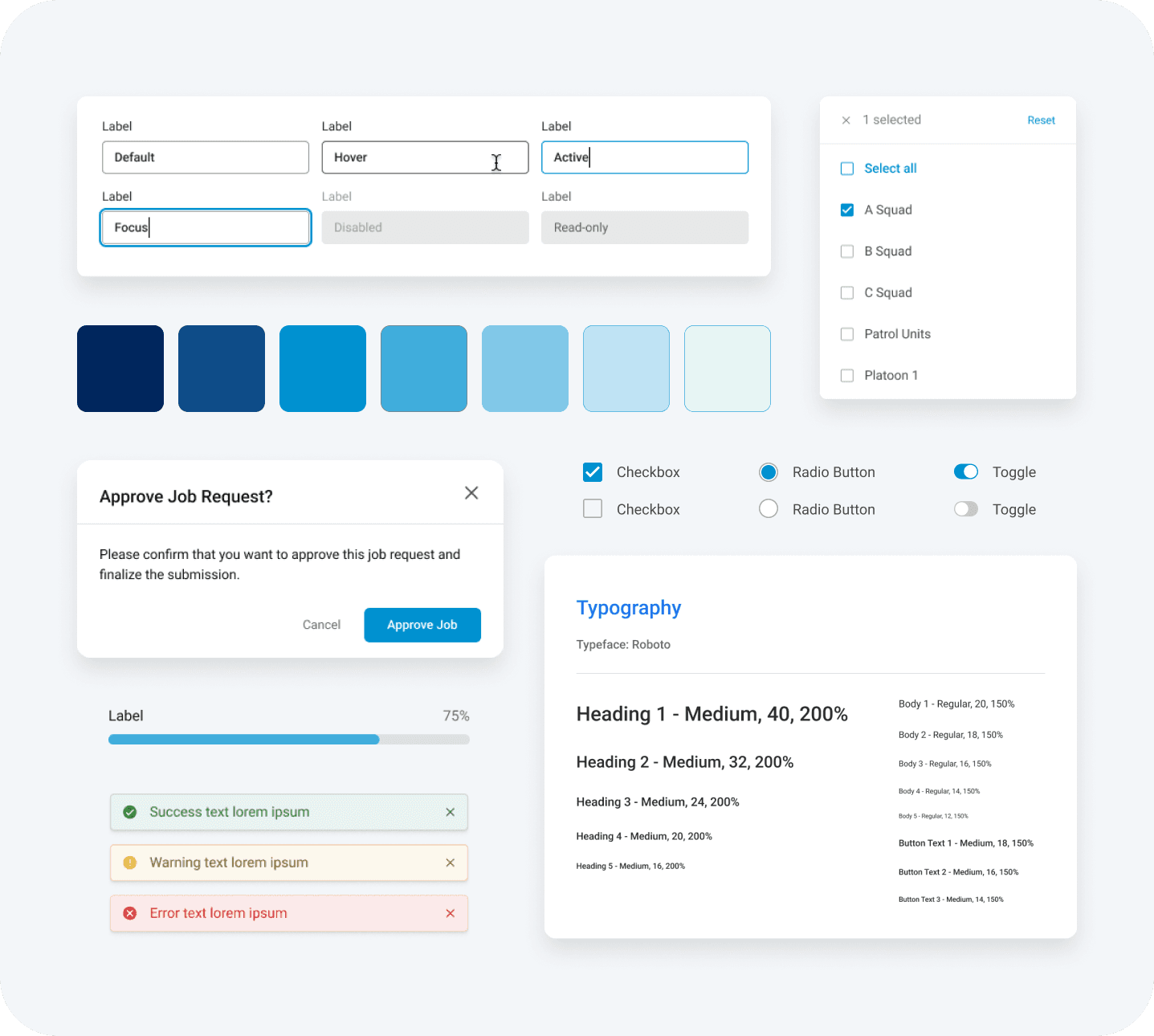
Introduced a modern, visually cohesive design system
Applied consistent typography, spacing, and layout patterns
Elevated overall look and feel to build trust and product legitimacy
02
02
02
02
Streamlining data entry with clean forms
Streamlining data entry with clean forms
Streamlining data entry with clean forms
Streamlining data entry with clean forms
Challenge
Form design was unstructured, cluttered, and cognitively taxing.
Design Approach
Designed clean, structured forms using familiar UX patterns
Improved field grouping and labeling for clarity
Increased scannability and accessibility to speed up input
03
03
03
03
Reducing workflow interruption with modal-based interractions
Reducing workflow interruption with modal-based interractions
Reducing workflow interruption with modal-based interractions
Challenge
Users were frequently redirected away from their current context to complete simple tasks.
Design Approach
Implemented robust search functionality
Added filtering options to refine results
Enabled faster access to relevant data
04
04
04
04
Enhancing information retrieval with search and filters
Enhancing information retrieval with search and filters
Enhancing information retrieval with search and filters
Challenge
Users struggled to locate specific information within dense data views.
Design Approach
Implemented robust search functionality
Added filtering options to refine results
Enabled faster access to relevant data
05
05
05
05
Guiding users through progressive disclosure
Guiding users through progressive disclosure
Guiding users through progressive disclosure
Challenge
Overwhelming amounts of information (both relevant and irrelevant) made workflows harder to follow.
Design Approach
Structured interfaces to reveal information step-by-step
Prioritized relevant content based on user actions
Reduced cognitive load and improved task flow
BEFORE/AFTER COMPARISONS
BEFORE/AFTER COMPARISONS
Featured selections of visual redesign
Featured selections of visual redesign
Login Screen
Login Screen
Login Screen
Landing Screen & Information Architecture
Landing Screen & Information Architecture
IMPACT
IMPACT
IMPACT
Redesigned the foundation for efficient, scalable operational workflows
Redesigned the foundation for efficient, scalable operational workflows
Built with a user-centered approach and high-volume operational needs in mind, Jobs4Blue established a streamlined platform that improved coordination, visibility, and execution across enterprise teams.
Built with a user-centered approach and high-volume operational needs in mind, Jobs4Blue established a streamlined platform that improved coordination, visibility, and execution across enterprise teams.
Built with a user-centered approach and high-volume operational needs in mind, Jobs4Blue established a streamlined platform that improved coordination, visibility, and execution across enterprise teams.
Simplified Request Management
Simplified Request Management
Created intuitive workflows that reduced friction when reviewing, prioritizing, and managing operational requests.
Created intuitive workflows that reduced friction when reviewing, prioritizing, and managing operational requests.
Reduced Operational Complexity
Reduced Operational Complexity
Consolidated fragmented workflows into a single experience that simplified day-to-day coordination.
Consolidated fragmented workflows into a single experience that simplified day-to-day coordination.
Improved Information Visibility
Improved Information Visibility
Surfaced critical request data, status indicators, and priorities where teams needed them most.
Surfaced critical request data, status indicators, and priorities where teams needed them most.
Accelerated Decision-Making
Accelerated Decision-Making
Enabled faster action by reducing navigation depth and highlighting the most important information.
Enabled faster action by reducing navigation depth and highlighting the most important information.

Enabled Organizational Scale
Enabled Organizational Scale
Established scalable patterns capable of supporting additional workflows, teams, and operational growth.
Established scalable patterns capable of supporting additional workflows, teams, and operational growth.

Created a Scalable Platform Foundation
Created a Scalable Platform Foundation
Provided the groundwork for future enhancements, integrations, and continued product evolution.
Provided the groundwork for future enhancements, integrations, and continued product evolution.
MOVING FORWARD
MOVING FORWARD
MOVING FORWARD

Learnings
Learnings
Designing operational workflows requires understanding how people work in the real world
Designing operational workflows requires understanding how people work in the real world
Direct conversations with agents uncovered friction points that data alone could not reveal.
Dense operational systems require clear hierarchy, prioritization, and scan-friendly patterns.
Small workflow inefficiencies become significant at scale and influence every design decision.
Early stakeholder and user feedback reduced rework and improved adoption of the final solution.

Looking Ahead
Looking Ahead
Built to support growing operational demands
Built to support growing operational demands
Enhanced workforce planning and availability management
Advanced analytics and reporting for staffing insights
Improved communication and collaboration between agents and departments
Automation of repetitive scheduling and coordination workflows
Expanded support for future operational tools and integrations